Understand and configure concern restriction levels
Open the Restrictions tab
Section titled “Open the Restrictions tab”- Open Command.
- Select Safeguarding.
- Select Restrictions.
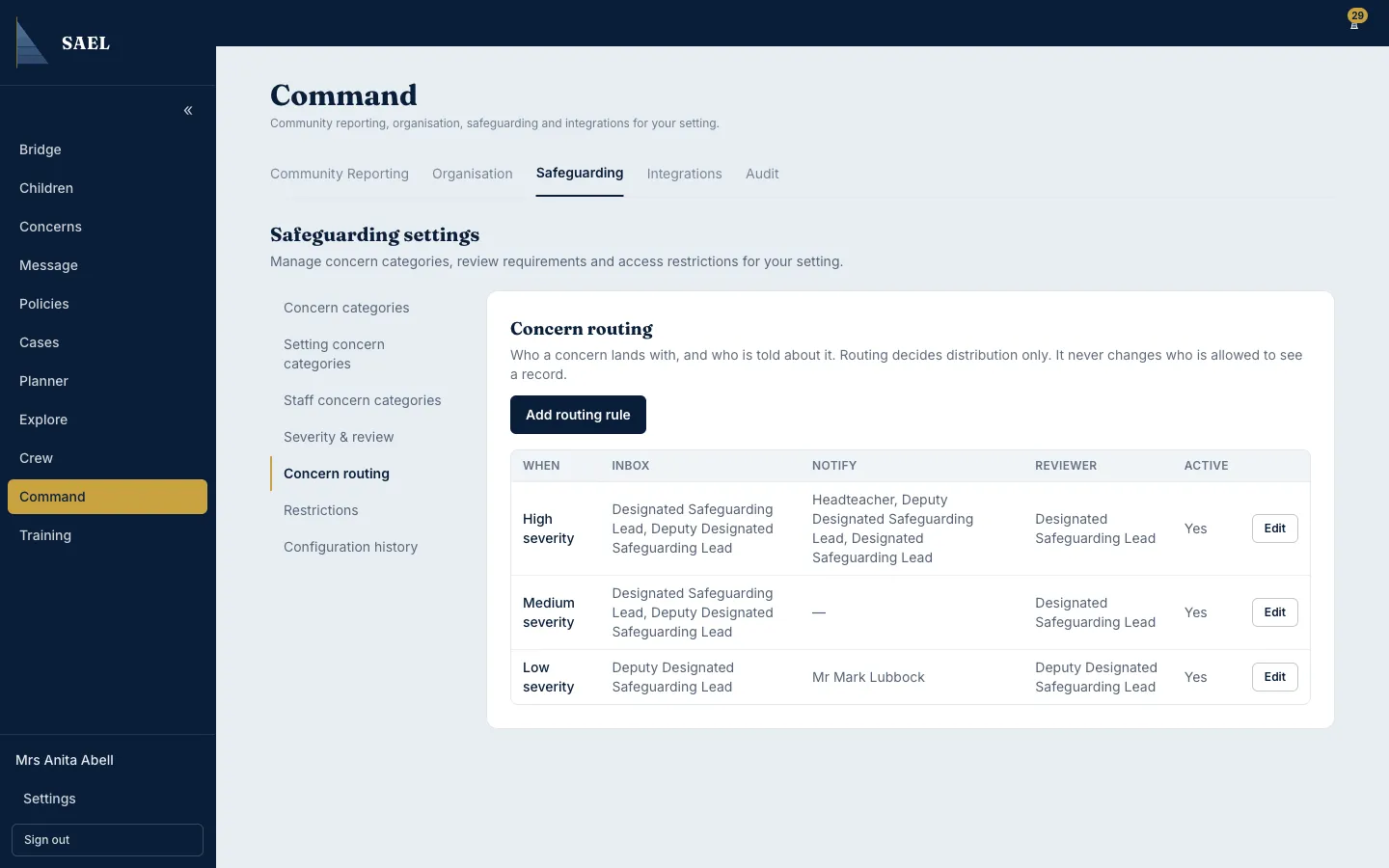
- Read the Concern restriction levels panel before changing any individual concern. Every concern has a restriction level which is initially set from its category and can be adjusted by the DSL on the concern itself.
Understand the three levels
Section titled “Understand the three levels”- Standard: visible to the safeguarding team in the normal way.
- Restricted: held more tightly; only people directly involved work on the record.
- Highly restricted: reserved for the most sensitive matters, such as allegations against staff.
The setting-level panel explains the levels; it does not show live counts. A count moving from zero to one could itself reveal that a restricted concern exists, so SAEL deliberately avoids displaying these counts.
Set the level on a concern
Section titled “Set the level on a concern”The default level comes from the concern’s configured category. If the DSL needs to change it for a particular record, open that concern and use the restriction-level control available on the concern itself. Check the record’s sensitivity, the people who genuinely need to work on it and your safeguarding policy before changing the level. The exact control may be presented within the concern’s governance/restriction area depending on the user’s permissions.
A restriction level is not the same as a staff-to-child access restriction. The former controls how a concern is held; the latter prevents one named staff member from viewing one named child’s record. See Restrict a staff member from a child’s record.
Do not choose a more restrictive level merely to hide an issue from appropriate safeguarding oversight. Equally, do not leave highly sensitive material at Standard simply for convenience.